


What's In The Solar System? | Science For Kids
- Erin and Out

- Dec 22, 2025
- 4 min read
Updated: May 28
1, 2, 3... Blast off! Beyond Earth's atmosphere, into the depths of space, lies the Solar System: a galactic neighborhood that orbits the Sun. Our Solar System includes the Sun and the eight planets, along with numerous moons, stars, and asteroids. In simple terms, if it travels around the Sun, then it's a part of the Solar System!


Learn about the Solar System while you color! Includes 8 hand-illustrated coloring pages with facts about the planets. Check it out -->
The Sun
At the center of the Solar System is the Sun: a medium-sized star that the planets orbit. The Sun's immense gravity is what holds the Solar System together as different planetary bodies are pulled along paths around it. Interestingly, despite the Sun's massive influence on the Solar System, the Sun is not nearly the largest star in space. In fact, compared to supergiants like Betelgeuse and Rigel, the Sun is quite small!
The Planets
The Solar System is composed of eight plants. The first four planets, Mars, Venus, Earth, and Mercury, are the Rocky Planets. The latter four planets, Jupiter, Saturn, Uranus, and Neptune, are the Gas Giants.
Mercury
The smallest of the eight planets is also the closest to the sun. Named after the swift Roman messenger god, Mercury completes its orbit in a speedy 88 days. That means one year on Mercury takes a little under 3 months! Other notable features include the planet's extreme temperature swings and heavily cratered surface. Mercury is kind of like an inhospitable version of our moon!


Venus
Venus may be the 2nd planet from the sun, but it's the hottest one there is! This is because, contrary to Mercury, Venus has a thick atmosphere that traps every ounce of heat it can. This makes the average temperature on Venus 867 F! Venus is wrapped in highly reflective clouds, making it the 3rd brightest object in the sky. If you ever wanted to say hi to another planet, step outside on a clear night and look for a steady stream of light. That'll be Venus winking back!




Earth
What planet might we know better than our very own Earth? Nicknamed the Goldilocks Planet, Earth has the ideal conditions to support life. It's particular distance from the Sun, coupled with its protective atmosphere, means that surface temperatures aren't boiling hot or freezing cold but, as the saying goes, just right. Earth also has liquid water, a core ingredient for every form of life.


Mars
Next to Earth is Mars, a dust-covered place nicknamed The Red Planet. This rusty sphere covered with canyons and volcanoes is actually fairly known to us, as its moderate climate has enabled scientists to land rovers on its surface. This has allowed us to closely examine Olympus Mon, the largest volcano in the Solar System, and Valles Marineris, a canyon 10 times the size of the Grand Canyon. We've even discovered water on Mars! What might it mean for the future?


Jupiter
Named after the Roman king of the gods, Jupiter dominates the other planets with its massive size. It's x1000 the size of Earth! Despite being the largest of the planets, Jupiter spins on its axis faster than any other; an entire day on Jupiter is a short 10 hours. Jupiter's size and speed, however, are not its standalone features. Jupiter is also home to The Great Red Spot, a massive storm (even bigger than Earth!) that has swirled for hundreds of years.


Saturn
Is there a planet with a more iconic look than Saturn? Blinged with rings, Saturn also impresses with its size (its the 2nd largest planet in the Solar System) and number of moons (a whole 274 of them!). Like Jupiter, it's surface is a swirling mix of hydrogen and helium. Its seven rings, however, are solid chunks of rock and ice. Saturn is large enough that you can find it with your naked eye- its just its rings that require magnification.


Uranus
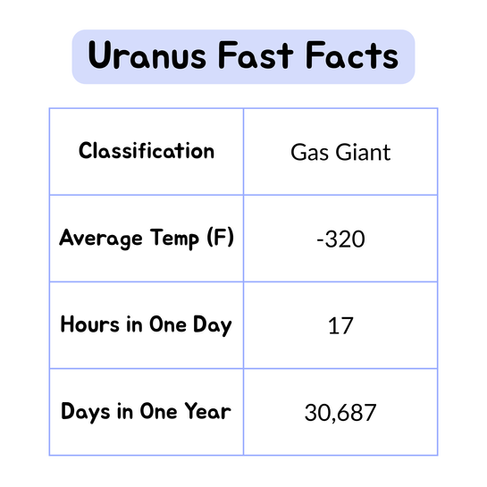
It may be the but as far as astronomy jokes go, but Uranus is as fascinating a planet as any other. For starters, Uranus has an extreme axial tilt of 97.7. This causes the planet to spin on its side. This tilt, along with the planet's 13 rings (did you know Saturn wasn't the only one?) gives the planet a unique look. Uranus is also the coldest of the planets, lacking an internal heat source. Scientists hypothesize that the collision that knocked Uranus onto its side also fragmented the planet's core. What was left? A lopsided planet that's frozen over!


Neptune
Far from the reaches of the sun lies Neptune. Named after the Roman sea god, the gas giant is a wonderful deep blue color. Still, don't go to Neptune expecting a beach day. The planet's bone-chilling temperatures, coupled with the Solar System's fastest winds, makes this a look-but-don't-touch kind of place. Interestingly, Neptune is the first planet discovered by math. Mathematicians predicted the existence of Neptune a whole year before it was seen through a telescope!


Other Objects in the Solar System
Moons
A moon is a rocky body that orbits a planet. We often think of our own moon, which appears to change shape as it orbits the Earth, but there are in fact many moons across the Solar System. Saturn alone has 274!
Asteroids
Asteroids are chunks of rock that orbit the sun. Occasionally, asteroids will get pulled out of orbit and collide with a planet. Some scientists believe that it was an asteroid collision that's responsible for wiping out the dinosaurs.
Comets
Comets are chunks of ice that orbit the sun. Just like asteroids, comets can be pulled away from the sun and crash onto unsuspecting planets. Because of their composition of rock and ice, comets are nicknamed "Dirty Snowballs."
Color and explore the planets with these coloring pages! A creative activity to discover the Solar System. Check it out -->


Comments